Avito — Redesigning the 360 Review Experience

| Year | 2018–2021 |
| Role | Senior Product Designer |
| Scope | Product Design, UI/UX, HR Tech |
| Other Avito cases | Read Avito Work case |
When you have 3,500+ employees, even small inefficiencies add up quickly. At Avito, one of the biggest classifieds platforms in Europe, the 360 review process had quietly become one of those inefficiencies.
Individual contributors spent around 8 hours per quarter filling in reviews. Managers often spent twice as long. Multiply that across thousands of people, and you get tens of thousands of working hours eaten up by clunky spreadsheets and outdated forms.
We needed to fix that. More importantly, we needed to make the 360 review experience less painful and more meaningful — something employees and managers alike could actually benefit from.
Context
Avito.People was our employee "super-app." It included personal profiles, benefits, the company's knowledge base, learning resources, and feedback tools. In 2020, it even won the IntraTeam Award for best corporate intranet.
But one core ritual — the 360 review — still felt stuck in the past. Our mission was to redesign it, integrate it fully into Avito.People, and make it a process employees wouldn't dread.
My role
I was the sole designer on the 360 review redesign. My responsibilities included conducting discovery interviews and analysing existing review flows, prototyping early versions (sometimes in Excel for speed!) and testing them with users almost daily, running hi-fi design iterations in Figma and presenting them weekly, managing expectations of HRBPs and C-level stakeholders, and delivering specifications to engineers and supporting them through hand-off. In other words, I owned the design end-to-end — from framing the problem to shipping the new experience.
Discovery & early validation
Our initial hypothesis was simple: if we could make reviews twice as fast, we'd save Avito thousands of hours each year.
I started with user research: employees wrestling with Excel, managers feeling overwhelmed, HRBPs worried about adoption. Security constraints also ruled out off-the-shelf tools like HiBob, which meant we had to build everything in-house.
We decided the new service should be measurably faster, provide clear guidance and criteria, and keep everything inside Avito.People to reinforce a holistic employee experience.
Ideation & prototyping
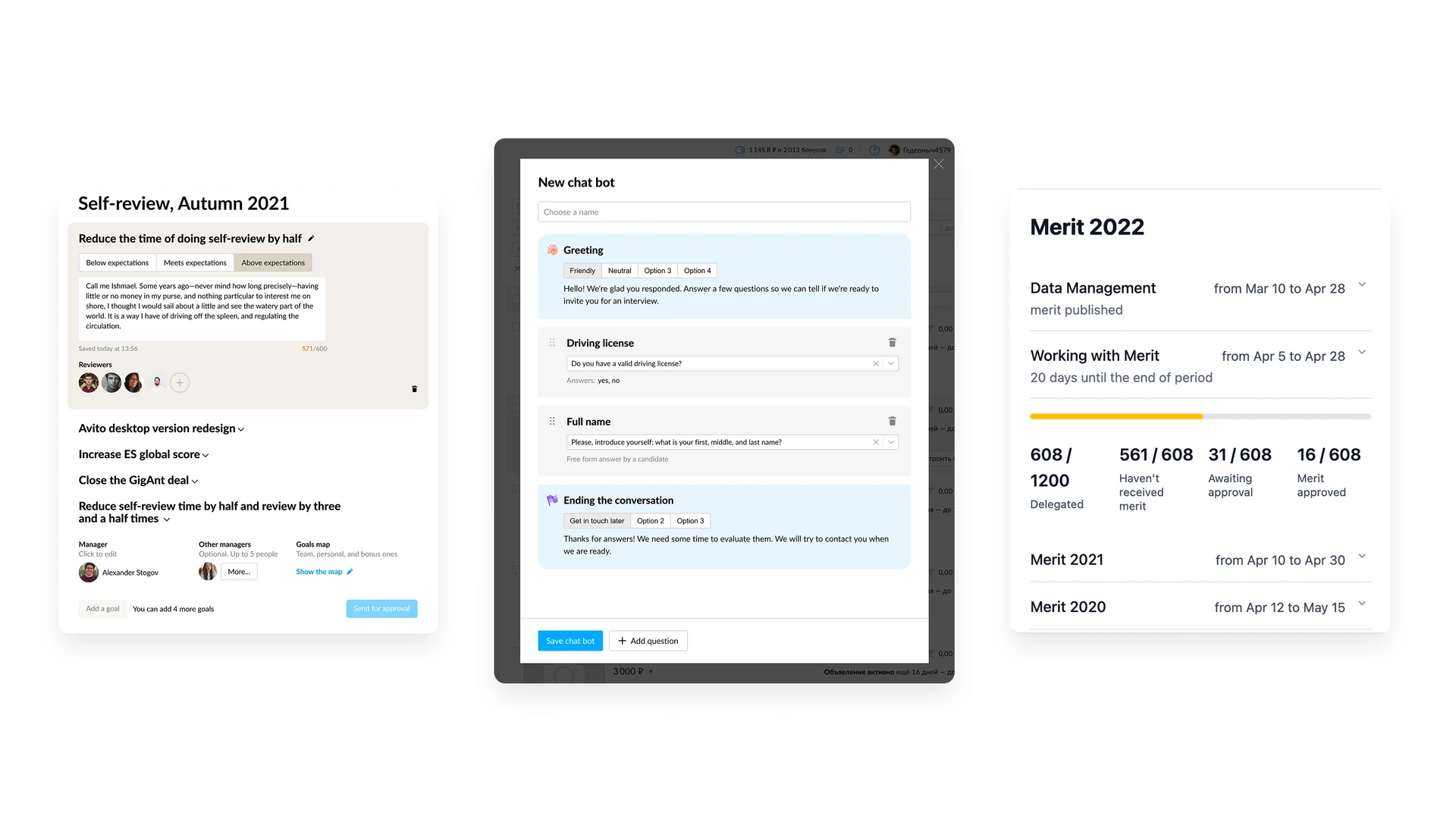
One of the first UX directions was to reduce choice fatigue: replacing endless free-form text with guided answers, shorter fields, and character limits.
Another was to structure reviews around skills, goals, and OKRs. Instead of vague feedback, employees could clearly see what to reflect on and how it aligned with team objectives.
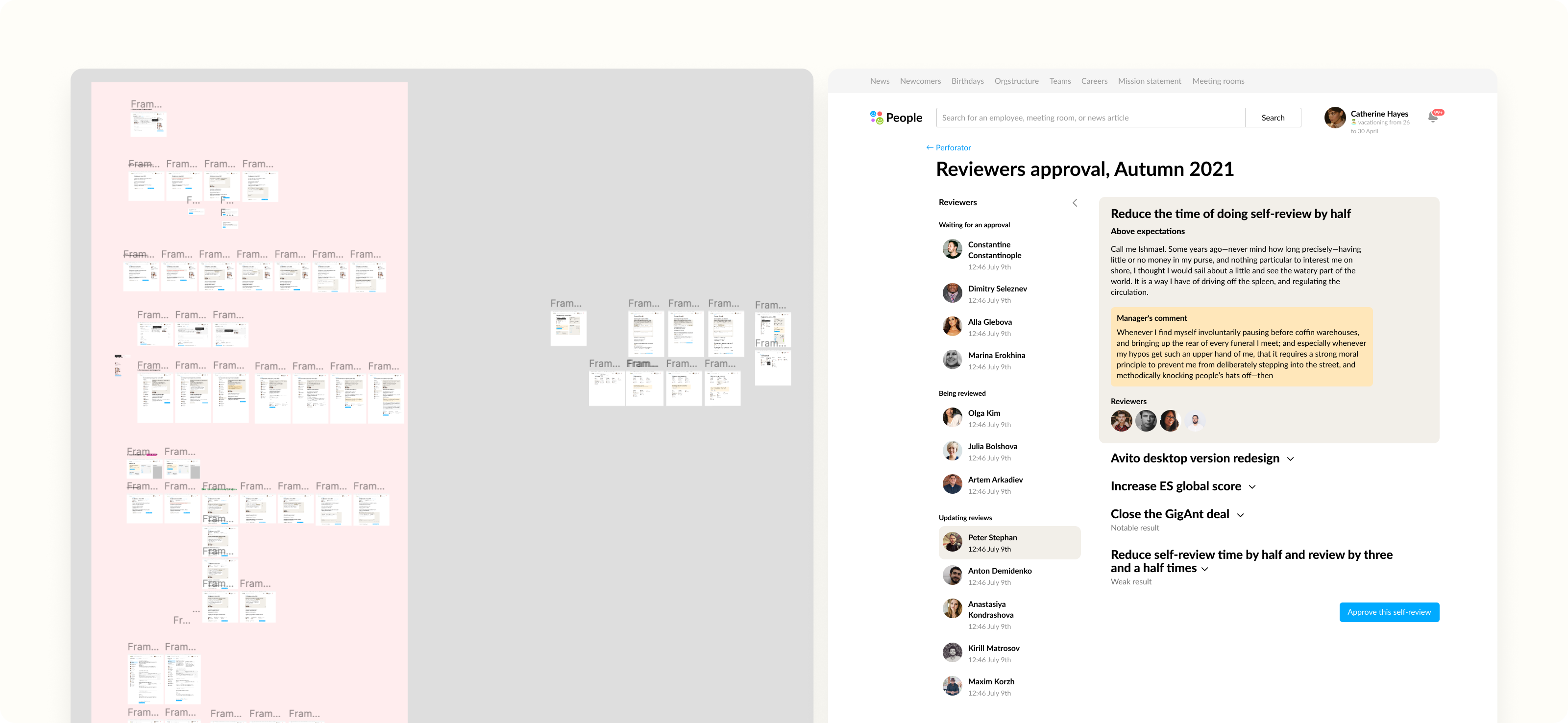
To validate quickly, I built lo-fi prototypes in Excel. Yes, Excel. It allowed us to click through scenarios and test them with employees almost daily. Once flows felt right, I translated them into hi-fi Figma designs for broader feedback.
Our motto was: simplify everything.
Results
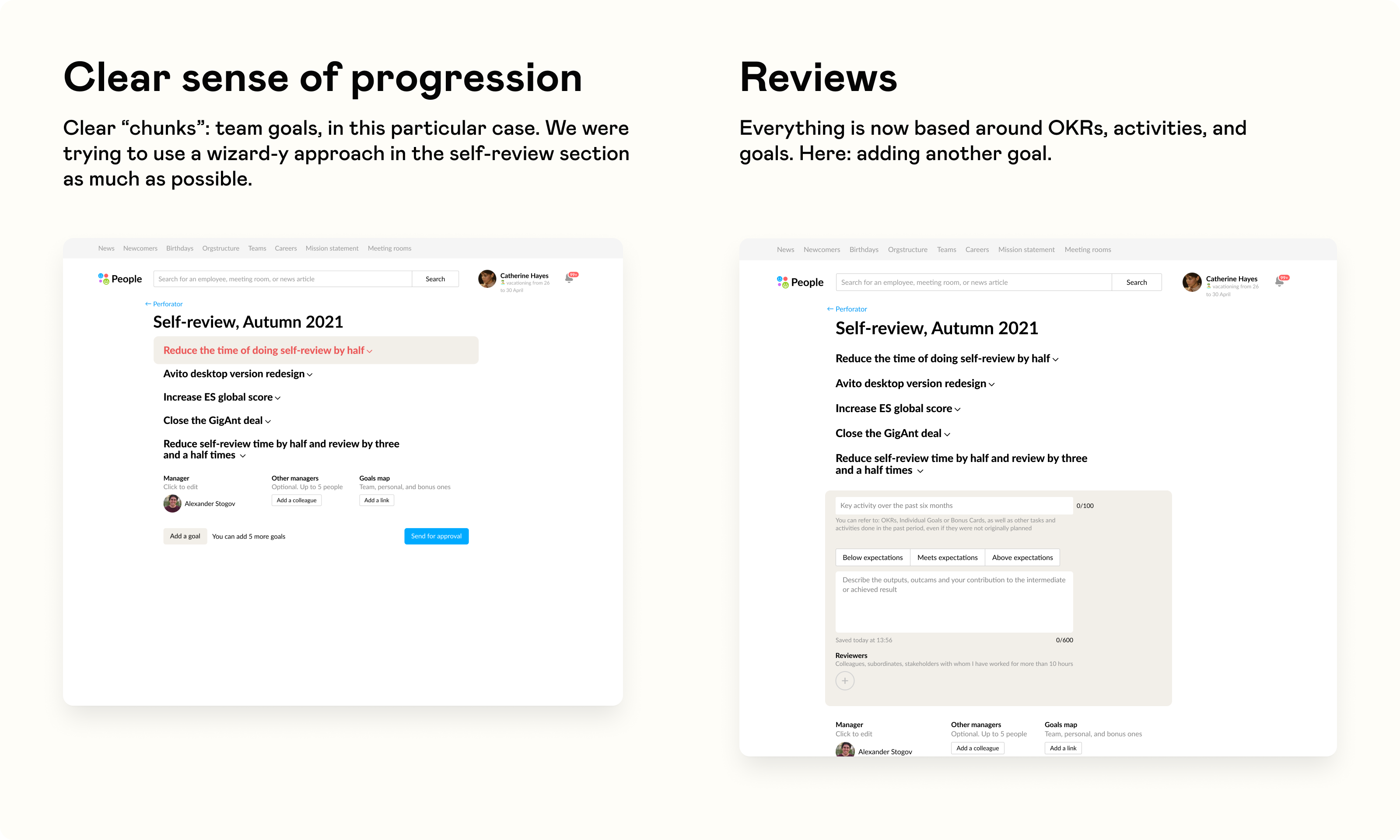
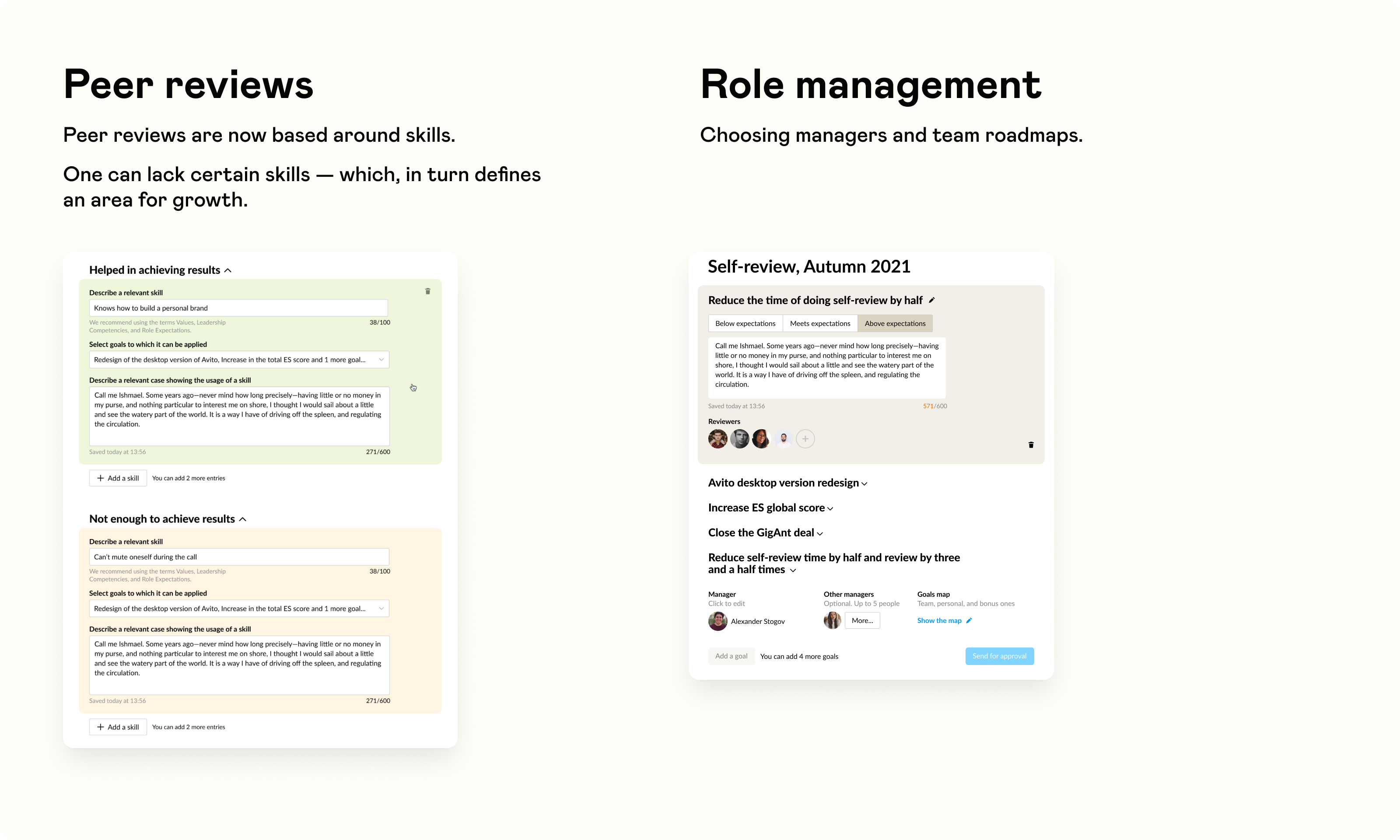
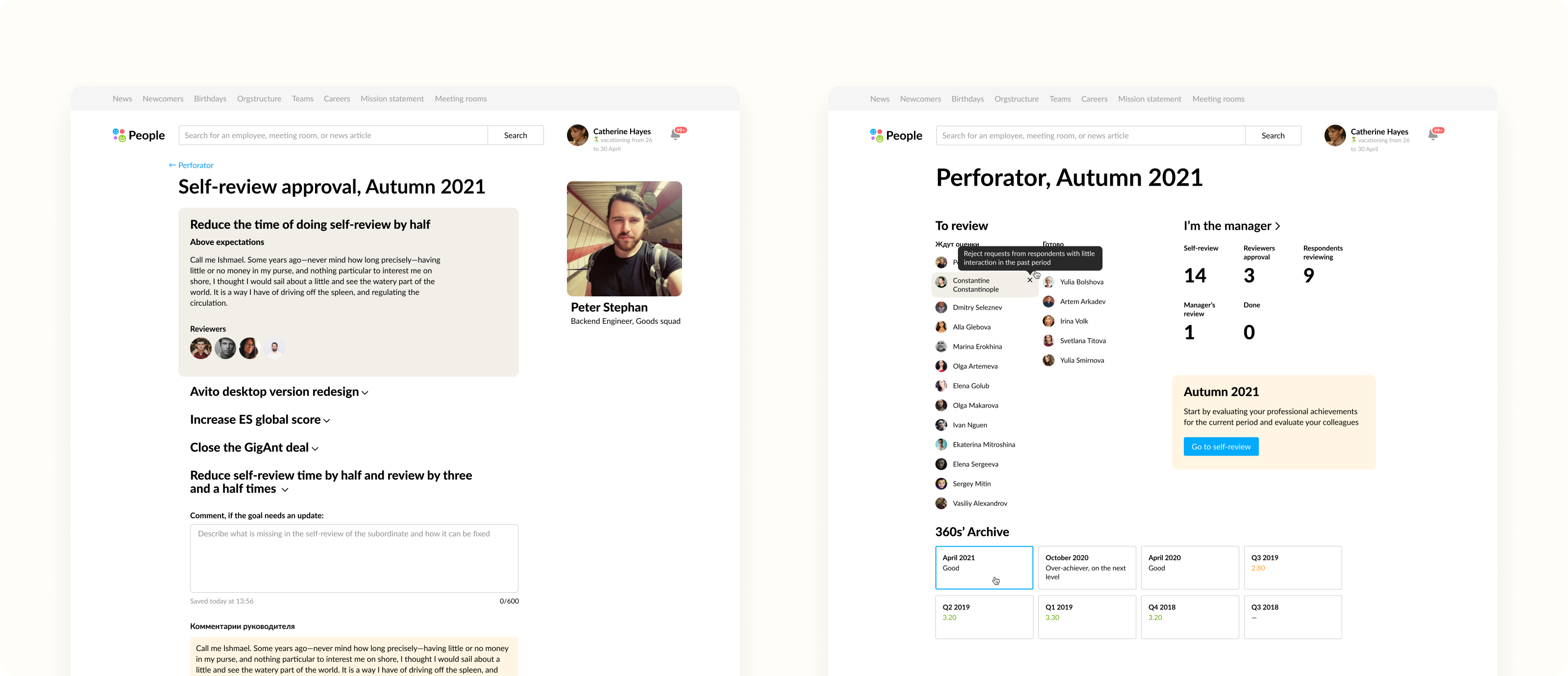
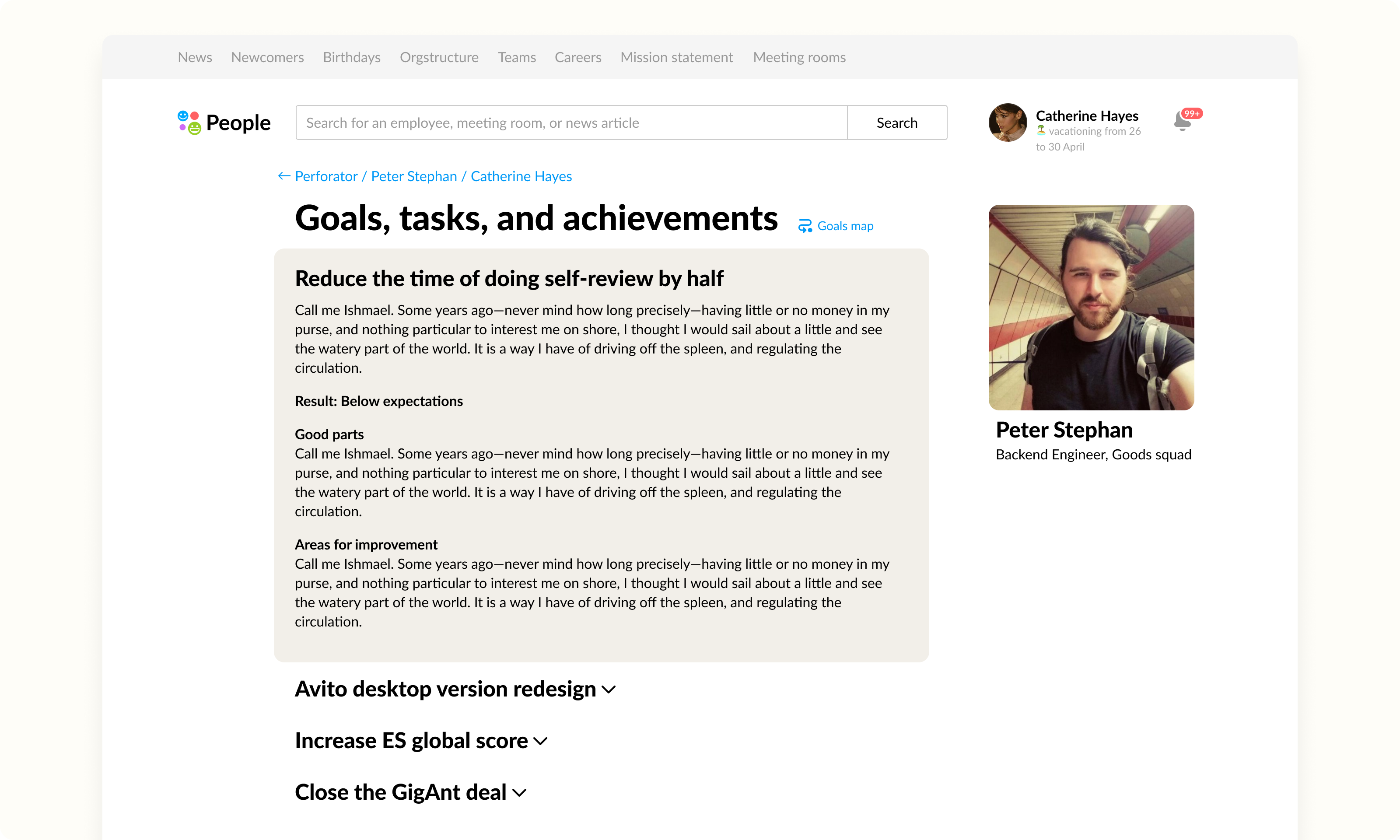
From inception to shipping, the project took just 3 months.
Adoption was strong: many teams embraced the redesigned 360 as their new routine. For employees, the process felt less like a bureaucratic checkbox and more like a structured reflection tool.
Challenges & tradeoffs
Not every idea made it. For example, we dropped a feature that displayed all respondents on one page; it was too heavy to implement within our timeframe.
We also had to balance transparency with simplicity. Managers wanted detailed views, but employees needed streamlined flows. Striking that balance was an ongoing conversation with stakeholders.
Learnings
Looking back, three key lessons stand out: low-fi matters — even Excel can be a powerful prototyping tool. Clarity beats freedom: by guiding users with structured inputs, we reduced fatigue and confusion. And culture is part of UX: at Avito, simplifying the 360 review wasn't just a workflow upgrade; it reinforced a company-wide culture of feedback and growth.
Closing thoughts
Redesigning the 360 review was one of those projects where design visibly moved the needle. We didn't just save hours; we made feedback less painful and more actionable. For a company of Avito's scale, that impact compounds. And for me as a designer, it was a chance to prove that even in conservative domains like HR processes, thoughtful design can make people's working lives noticeably better.